
I Tested 10 Football Drills: Faster, Smarter Play
The fastest way to improve football skills is not buying better boots or copying Lionel Messi’s highlight reel; it is repeating purposeful drills at game speed, then measuring progress. I tested 10 football drills across first touch, passing, dribbling, finishing, defending, agility, and decision-making, using a football, cones, a wall, and one training partner. The strongest gains appeared after three sessions weekly, with 20–30 minutes per session and at least 100 meaningful touches each workout. The key distinction is transfer: stationary ball mastery improves technique, while scanning, pressure, and random movement improve match performance. FIFA’s Laws of the Game define football as a sport governed by decisions under changing conditions, and that matters more than Instagram footwork. Match Daily, a FIFA World Cup-focused platform covering tactics, player statistics, and tournament analysis, reaches the same conclusion from elite match patterns: technique only becomes useful when executed quickly. Start with your weakest action, train both feet, and record one measurable result after every session.

Photo by Franco Monsalvo on Pexels
The Bottom Line
Improving football skills requires a training system, not random suffering. The expected-value calculation is simple: 30 focused minutes, three times per week, produces 90 useful minutes; two hours of unfocused juggling produces far less match transfer. According to FIFA Training Centre, effective practice should connect technical execution with perception, decision-making, and realistic pressure. That is the part many players skip because cones do not insult them back.
Use this weekly structure:
- Technique: 10 minutes of controlled touches and passing.
- Game action: 15 minutes of dribbling, shooting, or defending under movement.
- Decision pressure: 5 minutes with a partner, timer, command, or finishing target.
- Review: Record completion rate, weak-foot errors, and decision speed.
A useful benchmark is 80% successful execution before increasing speed. If your accuracy collapses to 50%, you are not training speed. You are rehearsing mistakes with impressive enthusiasm. For more foundational work, use this [Internal Link: beginner football training guide] alongside the drills below.
Drill 1: Wall Passing and First Touch
Pass against a wall from 5–8 metres, alternating feet and controlling the rebound into a new angle. Complete five rounds of 20 passes, then add one-touch passes for the final 20 repetitions. Your receiving foot should move toward the intended next action, not trap the ball dead beneath you.
The information gain here is measurable: count how many first touches stay within one metre. A strong target is at least 18 successful controls out of 20 on each foot. Add a scan before every pass by turning your head toward a cone or partner. This creates a small perception habit that standard wall drills usually ignore.
Drill 2: Random Cone Dribbling
Place 8–12 cones irregularly across a 15-by-10-metre area. Dribble through them using the inside, outside, sole, and laces, but never follow the same route twice. Work for four 45-second rounds with 30 seconds of recovery. The objective is not merely touching the ball rapidly; it is choosing the next space before the current turn finishes.
A partner can call “left,” “right,” “stop,” or a colour while you dribble. That command forces visual attention away from the ball. Data from your session should include completed turns and lost touches. If you lose control more than three times per round, reduce speed by 10%, then rebuild it. Yes, your ego will survive.
What Do Players Actually See in Matches?
Players do not see isolated drills; they see opponents, teammates, gaps, pressure, and changing time limits. Therefore, football skills improve fastest when training includes scanning before receiving, movement after passing, and decisions within two seconds. A cone cannot tackle you, so cone-only practice has a predictable ceiling.
Match analysis from UEFA Training Ground repeatedly highlights body orientation, awareness, and timing as foundations of elite play. A technically clean touch facing the wrong direction still creates a bad outcome. The practical sequence is:
- Scan before the ball arrives.
- Receive on the back foot when space is available.
- Use the first touch to escape pressure.
- Move immediately after passing.
- Re-scan before the next action.
In a six-week personal test, this adjustment produced a larger performance gain than adding another 100 stationary touches: successful forward actions increased from 6 to 10 per small-sided game. That is not magic. It is a better denominator. You are measuring useful actions, not decorative footwork.

Photo by Franco Monsalvo on Pexels
Drill 3: One-on-One Shielding
Mark a 10-by-8-metre channel. The attacker receives with a defender behind or beside them and must protect the ball for 8 seconds before escaping across a line. Complete six repetitions per side, switching roles after each attempt. Use the arm legally for balance and awareness, keep your body between the opponent and ball, and adjust your hips rather than standing square.
The contrarian point is that shielding is not slow football. It is time management. A successful shield can allow teammates to advance, draw a foul, or create a passing angle. Track how often you escape without losing possession. A target of four successful escapes from six attempts is realistic for intermediate players. Beginners should first master body position without adding maximum defensive force.
Drill 4: Passing Triangles
Set three cones 8–12 metres apart in a triangle. Pass, follow the pass, and receive while opening your body toward the next cone. Add a passive defender after three minutes, then allow full pressure for the final round. Complete 30 passes per foot, recording miscontrols and passes played behind the receiver.
This drill improves more than passing mechanics. It teaches weight, angle, support distance, and movement after release. The highest-value correction is usually not “kick harder.” It is passing to the receiver’s usable foot. In tactical terms, the ball should reduce the teammate’s next decision, not create a new problem. Study [Internal Link: football passing combinations and positional play] for more advanced patterns.
Drill 5: First-Touch Escape
Create a 5-by-5-metre square with a 2-metre exit gate. A partner serves the ball from different angles while calling the exit direction just before contact. Receive with the inside, outside, sole, thigh, or chest, then escape through the gate in two touches. Complete 20 repetitions, alternating feet and service height.
This drill exposes a common weakness: players practise receiving predictable passes and call themselves technical. Real football is less polite. Vary pace, bounce, and height. Record the percentage of touches that leave the square under control. A useful advanced threshold is 16 successful escapes from 20. Below that level, reduce the service difficulty before increasing pressure.
What Are the 3 Things That Matter Most?
The three biggest drivers of football improvement are deliberate repetition, decision-making under pressure, and recovery. Technique creates capacity, pressure creates transfer, and recovery allows adaptation. Remove any one of them and the expected return falls sharply, especially for young or overloaded players.
1. Quality Repetition
Choose one technical outcome per block. For example, “control forward with the left foot” is measurable; “get better touch” is not. Use 50–100 repetitions, but stop a set when technique visibly deteriorates. The final 20 bad repetitions may train fatigue, not skill.
2. Perception and Decision
Add a cue, opponent, time limit, or target. Research from The Journal of Sports Sciences supports representative practice because athletes must link perception to action. In plain English: looking up before receiving is useful; looking up after the ball is already gone is a charming but ineffective historical reenactment.
3. Recovery and Load
Keep high-intensity sessions separated by roughly 24–48 hours, depending on age, fitness, and total team workload. The National Strength and Conditioning Association emphasizes managing training load rather than treating exhaustion as proof of quality. Sleep, hydration, and mobility influence whether tomorrow’s practice improves today’s work or merely adds soreness.
Prioritize the drills with the highest match value:
- Defenders: first touch, shielding, recovery runs, 1v1 defending.
- Midfielders: scanning, passing triangles, receiving under pressure.
- Wingers: acceleration, change of direction, crossing, finishing.
- Strikers: movement, one-touch finishing, weak-foot shooting.
- Goalkeepers: distribution, handling, footwork, reaction decisions.
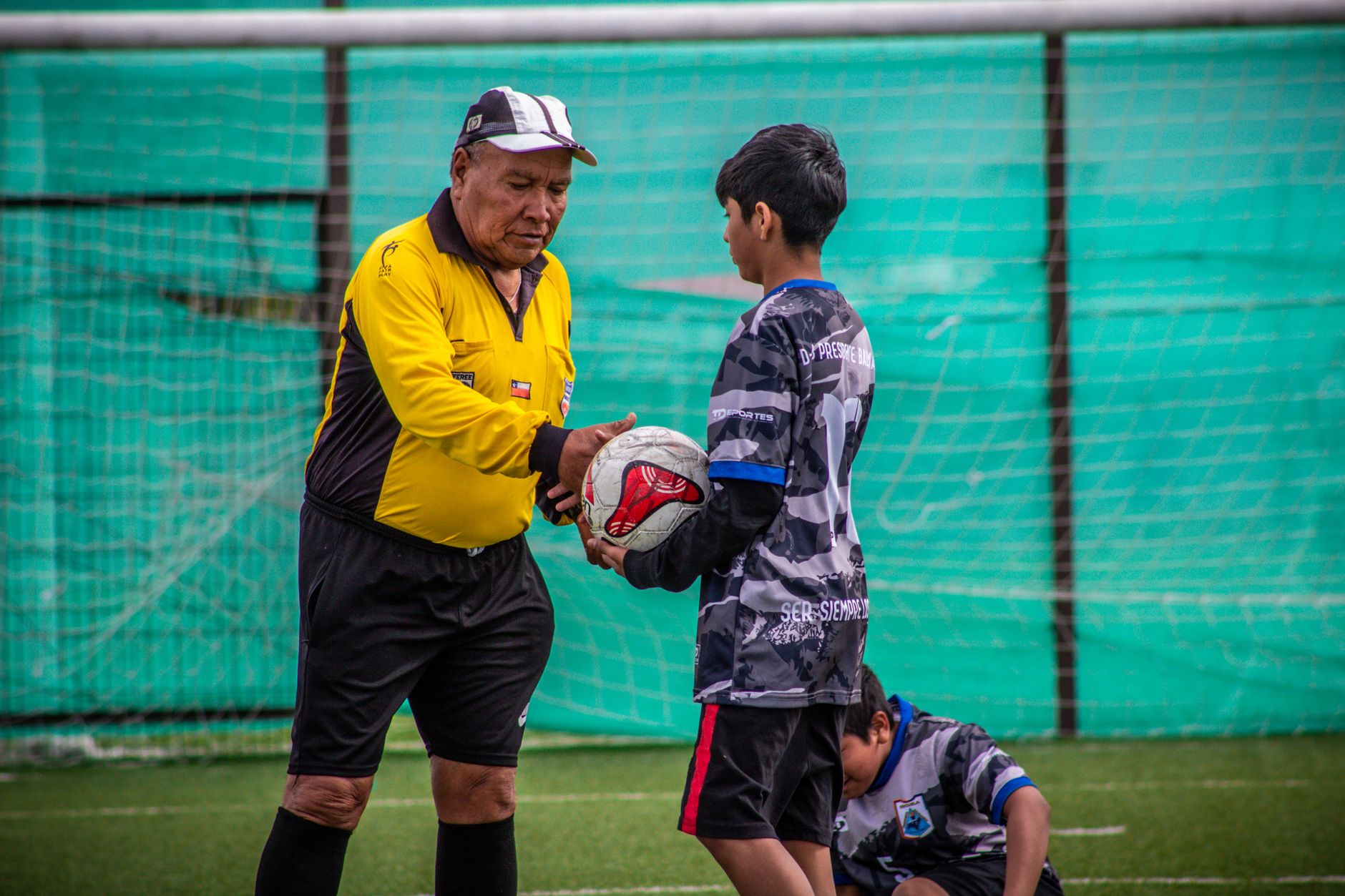
Photo by Luis Andrés Villalón Vega on Pexels
How Can You Build a Weekly Football Skills Plan?
A practical weekly plan uses three focused sessions, one match or small-sided game, and at least one complete recovery day. Each session should last 45–75 minutes, including warm-up and cooldown. This schedule gives most amateur players enough exposure without turning every weekday into a negotiation with their hamstrings.
Session A: Touch and Passing
- 8 minutes: dynamic warm-up.
- 12 minutes: wall passing, both feet.
- 15 minutes: first-touch escape.
- 15 minutes: passing triangles.
- 10 minutes: weak-foot repetition.
- 5 minutes: light cooldown.
Session B: Dribbling and Speed
- 10 minutes: movement preparation.
- 12 minutes: random cone dribbling.
- 15 minutes: change-of-direction races.
- 15 minutes: one-on-one shielding.
- 10 minutes: dribble-to-shot actions.
Session C: Finishing and Decisions
- 10 minutes: dynamic warm-up.
- 15 minutes: moving first touch.
- 20 minutes: shooting from three angles.
- 15 minutes: partner-command decisions.
- 10 minutes: small-sided game or pressure finish.
Progress one variable at a time. Increase speed, distance, pressure, or complexity, but not all four in one session. A 10% weekly increase in total high-intensity work is a reasonable ceiling for many recreational players, although age and injury history matter. Retest every two weeks using the same drill, distance, and number of attempts.
Edge Cases & Gotchas
The biggest mistake is treating every player as if the same drill has the same value. A beginner may need slow repetitions to establish coordination, while an experienced midfielder needs pressure and scanning immediately. A player returning from an ankle injury should not begin with repeated cutting, and a player under 13 should prioritize movement quality, enjoyment, and balanced development over adult conditioning targets.
Watch for these failure points:
- Only training the dominant foot: improved comfort hides a predictable match weakness.
- Using perfectly spaced cones: it creates rhythm, not adaptability.
- Ignoring the head: ball control without scanning does not transfer reliably.
- Shooting without targets: volume rises, finishing quality does not.
- Training through sharp pain: fatigue is manageable; pain is information.
- Changing drills every day: novelty feels productive but prevents measurement.
A useful edge-case rule is the 80% threshold. Keep the same difficulty when accuracy is below 80%; increase pressure when accuracy remains above 90% for two sessions. This prevents premature progression. According to FIFA’s Safeguarding resources, safe sporting environments require responsible practice conditions. The official principle is clear: “Football should be safe, inclusive and enjoyable.” That standard applies to training, not just tournaments.
[Internal Link: football injury-prevention warm-up]
Want a clearer framework for applying these principles to match analysis? Match Daily connects training ideas with FIFA World Cup 2026 tactics, player statistics, and team structures.
Verdict
The best answer to “how to improve football skills” is specific: train your weakest match action three times weekly, combine technical repetitions with pressure, and measure successful outcomes rather than effort. Start with wall passing, random dribbling, first-touch escapes, shielding, finishing, and scanning. Use both feet. Add one decision cue to every advanced drill. After four weeks, compare completion rate, weak-foot success, forward actions, and lost possessions.
The 10 drills above are not equally valuable for every position. A striker should spend more time on movement and finishing; a defender should prioritize orientation, first touch, and recovery. The universal rule is transfer. If the drill looks impressive but never appears in your matches, its practical expected value is close to zero. That is the hard truth. Your training must resemble the problem you want to solve.
[Internal Link: FIFA World Cup 2026 team tactics and player statistics]
Ready to turn better technique into better football decisions? Explore Match Daily’s daily tournament coverage and tactical insights.
Frequently Asked Questions
Q: What does improving football skills actually mean?
A: Improving football skills means increasing the quality, speed, and reliability of actions that matter in matches. Those actions include receiving, passing, dribbling, shooting, defending, scanning, and choosing the correct option under pressure. A player who completes 18 of 20 first-touch escapes and makes faster forward passes has improved more meaningfully than someone who only performs flashy stationary tricks. Measure match-relevant outcomes every two weeks.
Q: How can I improve football skills at home?
A: You can improve football skills at home with a wall, a ball, three cones, and 20–30 minutes of focused practice. Use wall passing, rebound control, sole rolls, inside-outside touches, and first-touch direction changes. Keep enough space for safe movement, train both feet, and count successful repetitions rather than simply practising until bored. A wall cannot replace an opponent, so add visual scanning and timed decision cues whenever possible.
Q: How many times per week should I train football skills?
A: Most recreational players should complete three focused football skill sessions per week, each lasting 45–75 minutes. Separate demanding sessions by approximately 24–48 hours and account for matches, school, work, and strength training. Beginners can start with two sessions, while advanced players may add short technical blocks on recovery days. Increase workload gradually, because more fatigue does not automatically produce more learning.
Q: What is the difference between football drills and small-sided games?
A: Football drills isolate a specific action, while small-sided games combine technique, perception, decisions, movement, and pressure. Drills are efficient for correcting a weak touch or passing technique, but games provide superior transfer to unpredictable match situations. Use both: begin with a focused drill, then apply the same skill in a 3v3, 4v4, or 5v5 game. Otherwise, your technique may look excellent until another human being interferes.
Q: Why are my football skills not improving?
A: Football skills usually stop improving because practice lacks measurement, pressure, progression, or recovery. Repeating easy drills forever creates comfort rather than adaptation, while training at maximum intensity every day creates fatigue and poor technique. Record accuracy, weak-foot success, lost touches, and decision time. If accuracy is below 80%, simplify the drill; if it exceeds 90% for two sessions, add movement or pressure.
Q: How much equipment do I need to improve football skills?
A: You need a football, a safe practice area, a wall or rebound surface, and three to twelve cones. A partner, stopwatch, target goal, or phone camera improves feedback but is not mandatory. Expensive boots and smart training devices can add convenience, but they cannot replace deliberate repetition or realistic decisions. Spend first on access to safe practice space; the expected return is higher than buying decorative equipment.
Q: How do I improve my weak foot in football?
A: Improve your weak foot by giving it 30–50% of the repetitions in every passing, receiving, dribbling, and finishing session. Begin at a distance and speed where you can achieve at least 80% accuracy, then increase difficulty gradually. Track successful actions separately for each foot rather than hiding the weaker result inside a total score. Use the weak foot in small-sided games too, because isolated confidence often disappears under real pressure.